Tuesday, 29 May 2012

Image gallery

Emma
2000
Oil on Canvas
(182.9x152.4cm)
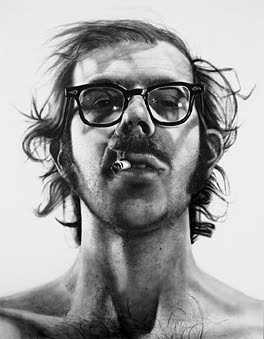
Big self portrait
1968
Acrylic on canvas
(273x212.1cm)
Lucas
1986
Oil on Canvas
(254x213.4cm)
Phil
1969
Acrylic on Canvas
(274.3x213.4cm)
Self-Portrait
1997
Oil on Canvas
(259.1x213.4cm)

Self portrait
1977
Etching hardground and aquatint
(137.2x104.1cm)

Tuesday, 22 May 2012

Links 2 3 4

I shall be linking to links that have helped me find information on Chuck Close.
These may include general webpages, like Wikipedia, or videos on Youtube.

http://en.wikipedia.org/wiki/Chuck_Close
General information about Close, his life and his artworks

http://www.chuckclose.coe.uh.edu/life/index.html
The main site I was referring to, it has Closes artworks and various other things. Something I would suggest that you have a look at would be the timeline.

http://nga.gov.au/International/Catalogue/Detail.cfm?IRN=37305
Information on Closes artwork "Bob".

http://www.chuckclose.com/
Closes official site, I will probably have a look at this site within the next week, mainly because I have not had a look on this site before.

http://www.washington.edu/alumni/columns/june97/close1.html
Some more things about Closes life.

http://www.youtube.com/watch?v=J7WPBXfNxZo&feature=fvst
I died a little bit inside when I watched this...

http://www.youtube.com/watch?v=lgsFYXsdcp0
This video was kind of just talking about Closes artwork, we also got to see how he paints.

http://www.youtube.com/watch?v=9s_pxtWtNeo
More stuff on his artwork. People were saying that they prefer his newer work over his old work.

http://www.youtube.com/watch?v=sGAkYNQmr-k&feature=fvsr
http://www.youtube.com/watch?v=sWaKDI1jQ7M&feature=relmfu
The above two Youtube links are interviews with Chuck Close.

http://www.youtube.com/watch?v=8jc0ygo3HKs&feature=fvsr
More interviews of Close

http://www.youtube.com/watch?v=GxR3ELuZjLw
A "Note to self" video about Chuck Close

http://www.youtube.com/watch?v=BkOyZQymJ2A
More stuff that I found.

http://www.youtube.com/watch?v=ykna0l9cpLA
If you have time, have a glance at this video. It is a full length conversation I believe.

If you get time, have a look trough all of the links that I have linked through out this blog.

Tuesday, 15 May 2012

Personal Analytical Framework


I will analyse the artwork by Chuck Close called “Emma” (2002) using the Personal Analytical Framework. I will be looking at his inspirations and reasoning for creating this artwork, also if there are any symbols or meanings in his artwork.
If you compare the artwork “Emma” to something like “Big self-portrait”, you can clearly see a difference in Close’s art style. This isn’t because he got bored of taking a photo of somebody then gridding it up to make it look photo realistic. It is because in 1988, Close suffered a heart attack of which left him paralysed from the neck down. After months in hospital and rehabilitation, Close was able to talk a short distance and able to move his wrists. He then created this new technique of which still briefly seems photo realistic, except he would gather up materials and have his assistant grid up his images. We can see this in his artwork “Emma”.
 In the artwork we can see all different types of shapes and colours of which make up an image of his niece Emma. The technique that Close used was he woodblocks of which his assistant spent weeks cutting up for him so that he could apply them to his artwork. This allowed his image to be created and allows us to see an image behind all of the woodblocks.
Majority of Close’s artworks are of friends and family. In the artwork “Lucas” he used the woodblocks to create an image of an artist named Lucas Samaras. From afar, we can see that his woodblocks are of an actual person, but close up all of the woodblocks seem individual and abstract.
Using the Personal Analytical Framework, we are able see that due to the event, Close was forced to change his art style, to continue to become a well known artist.

Formal Analytical Framework


I will be using the formal analytical frame work to analyze the artwork “Bob” by Chuck Close created in 1970. I will be analyzing the artwork using the elements and principles of design, looking at the techniques he has used to create the artwork, exploring what type of style he has used and any metaphors and symbols he may have used in his artwork.
The elements and principles have been applied to this artwork by using elements and principles like tone, emphasis, contrast, form, texture and focal point. Close uses tone to create a dark shade in his artwork, this helps make the artwork seem more realistic. Contrast is a large part of this artwork; it shows the realism in the artwork by having the black on white in different parts of the artwork. The texture of the artwork seems smooth; we can easily see the smoothness of the skin because of the tone and emphasis of the lines in the artwork. The focal point of the image is around his eyes and glasses.
The technique that Close uses is a girding technique. The way Close goes about with his technique is that he will find a photo that he has taken and then will grid the image and then transfer that over to another piece of paper or whatever he chooses to work on. The effect of this technique is that the artwork almost looks exactly the same as the original photo. The artist was trying to portray a general image of himself.
The processes the artist has used to create the artwork are using a camera to capture the image he wants to draw and then gridding the image to blow it up and draw it. The influence of Close’s work is to make photo realistic artworks. The artwork is realistic. What the artist has done with his technique is that he has taken photography to the next step by actually drawing the image in an exact copy of what he had with the image.
The artist hasn’t used any symbols or metaphors in this image, the only symbol that I could figure that would be classed as a symbol would be the fact that the artwork is photo realistic.
In the artwork “Bob” by Chuck Close, we see a range of elements and principles of art, such as tone, emphasis and texture. Due to his gridding technique, it has allowed him to make his artwork to seem realistic. His style of photo realism allows him to use the elements and principles to create this type of artwork.

Tuesday, 1 May 2012

Getting to know Chuck Close

Big self-Portrait, 1967
Acrylic on canvas .
273 x 212 cm
Chuck Close is an American painter that was born on July 5th, 1940 in Monroe, Washington.
When he was 14, he went to an art exhibition for an abstract painter named Jackson Pollack, who helped inspire Chuck to become a painter.
In his career, he had based his portraits from images that he took using a camera and then would paint them in a photo realistic/Minimalist/Abstract Expressionist style.
To help him get a photo realistic image, he would grid his work, the making of an artwork could take up to 2 years to complete, this could be because Close works by hand.
On December 7th, 1988, Close had suffered a heart attack of which left him paralyzed from the neck down. Months after the heart attack, he was able to move his wrists and briefly could walk.
He strapped drawing and painting utensils to his wrists and had an assistant draw up his grids.